Time 0:00
Moves 0
Stock 24
Pass
Score 0

Game Paused

Take your time — your game is safe

Auto-complete available!

Klondike Solitaire

The goal is simple: move all 52 cards onto the four Foundation piles, one per suit, built up in order from Ace to King.

Klondike is the world's most recognised patience card game — the one that shipped with every copy of Windows for decades and introduced millions of people to solitaire. Its name comes from the Klondike region of Canada, though the game itself likely predates the Gold Rush era. Today it remains the definitive single-player card game, equally at home on a felt tabletop or a touchscreen.

How to Play

The Layout

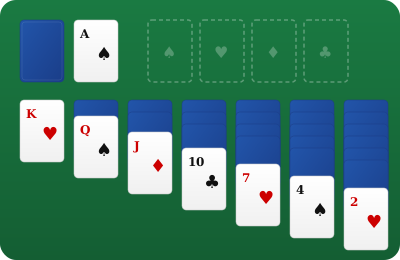
The game opens with seven Tableau columns. Column 1 has one card face-up; column 2 has one face-down and one face-up; and so on up to column 7. The remaining 24 cards sit face-down in the Stock pile. Four empty Foundation piles wait in the top-right corner, one for each suit.

Your Goal

Move every card to the Foundations. Each Foundation pile starts with an Ace and is built up in the same suit — Ace, 2, 3 … Queen, King. Fill all four piles and you win.

Moving Cards in the Tableau

Drag a face-up card (or a stack of face-up cards) onto another Tableau column. The card you place must be one rank lower and the opposite colour to the card it lands on — for example, a red 7 on a black 8. Only a King (or a stack led by a King) may be placed on an empty Tableau column.

Drawing from the Stock

Click the Stock pile to flip the top card face-up onto the Waste pile. You can play the top Waste card at any time. When the Stock runs out, click it again to recycle the Waste back into the Stock (a score penalty applies).

Sending Cards to the Foundations

Drag an eligible card to a Foundation pile, or double-click it to send it there automatically. Use the Auto-Move button in the header to move every currently eligible card to the Foundations in one action.

Undo

Click the Undo button (or press Ctrl+Z / Cmd+Z) to reverse your last action. You can undo all the way back to the opening deal.

Rules — Step-by-Step

  1. Shuffle & Deal — The 52-card deck is shuffled and dealt into 7 Tableau columns. Column N receives N cards; only the top card of each column is face-up. The remaining 24 cards form the Stock.
  2. Tableau builds down in alternating colours — A face-up card may be placed on any Tableau card that is exactly one rank higher and the opposite colour (red on black, black on red).
  3. Only Kings fill empty columns — When a Tableau column is cleared, only a King (or a stack led by a King) may be moved there.
  4. Move stacks as a unit — Any sequence of face-up cards in correct alternating-colour order may be dragged and dropped together onto a valid Tableau card.
  5. Flip the top face-down card automatically — Whenever a move exposes the top face-down card of a Tableau column, it flips face-up immediately.
  6. Draw one card at a time from the Stock — Each click on the Stock moves the top card face-up onto the Waste. Only the top Waste card is in play.
  7. Recycle the Waste — When the Stock is empty, click it to turn the entire Waste pile face-down back into the Stock. A penalty of 100 points is applied each time (minimum score is 0). If a pass limit is set, recycling is disabled once the limit is reached.
  8. Build Foundations from Ace to King — Each Foundation pile accepts cards of one suit in ascending order: Ace first, then 2 through King. The suit is fixed by the first Ace placed.
  9. Move cards back from a Foundation — A card on a Foundation pile may be dragged back to the Tableau if the placement is valid, though a score penalty applies.
  10. Win by completing all four Foundations — Place all 52 cards on the four Foundation piles (13 per suit, Ace through King) to win the game.

Keyboard Shortcuts

KeyAction
← → ↑ ↓ Arrow keysMove the keyboard cursor between piles
SpaceSelect the card(s) at the cursor, or confirm a move to the highlighted target
EscapeCancel the current selection
F2Start a new game
Ctrl+Z / Cmd+ZUndo the last action
AAuto-move all eligible cards to the Foundations